Feasible Is Not Faithful
Task Preservation in Feasibility Restoration
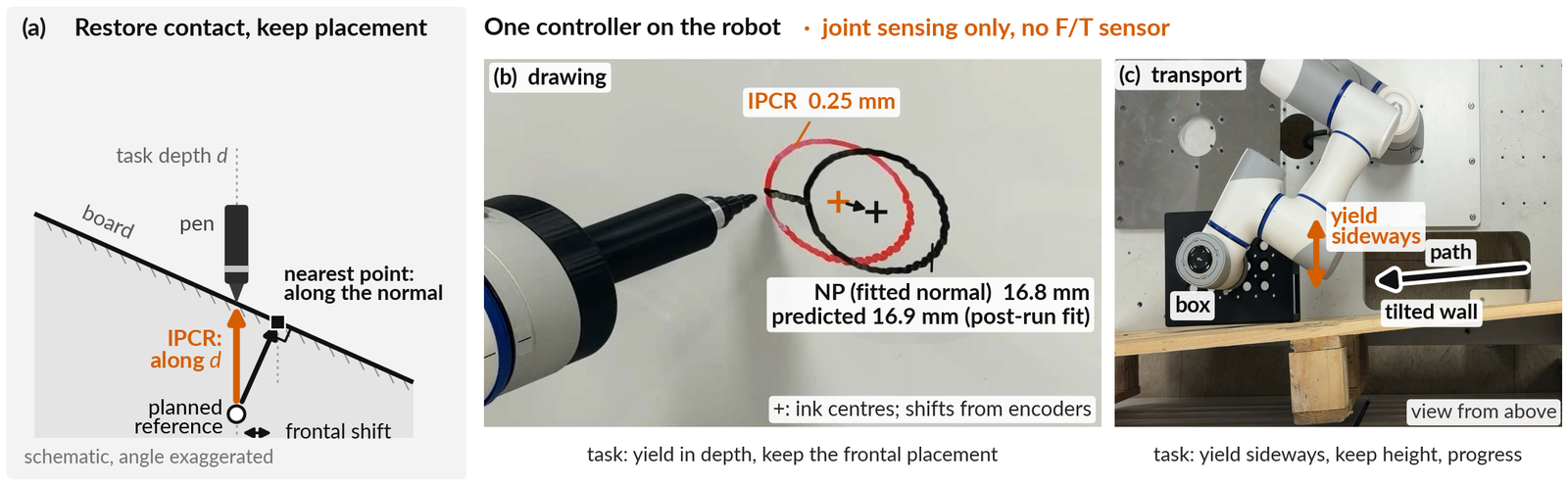
Restoring contact can quietly move what a task prescribes. For static affine corrections, the prescribed coordinates are kept exactly when the correction stays in directions the task permits; for other directions, their displacement can be predicted before the run. We test this on contact with unknown surfaces.
School of Mechanical Engineering, Korea University
Paper after submissionCode after reviewRobot videosCite
Motivation
Restoring contact can move the task
References planned from a model become infeasible on the real surface, and many corrections restore contact and regulate force equally well. They differ in what they keep, and tracking, force and contact are all measured against the corrected point, so none of them shows where the task ended up. The choice arises in safety filtering, constrained policies, MPC and compliant control; we characterize it for static affine corrections.
Feasibility leaves a task decision open: which coordinates may change to restore contact?
Key idea
Let the task choose the correction direction
The task names the coordinates it must keep, , and the directions in which it may yield, . Within a static affine model, three results follow for any correction direction .
1 · Preserve
Correct inside what the task permits
For correction amounts that span the mismatches, the prescribed coordinates are kept exactly when the correction directions lie in .
2 · Reach
Check that contact is reachable
Every constraint can then be met while keeping ; the point is unique when is square and invertible. If the rank test fails, some mismatches cannot be corrected while keeping .
3 · Predict
Price any other direction
For invertible, correcting along moves the prescribed coordinates by , where is the mismatch removed, before anything runs.
Direction allocation (hybrid control), the oblique projector and the rank test are classical; the paper adds their task-relative characterization and the closed-form cost, tested prospectively. The nearest point is the right rule when the task lives on the surface, .
Method
Intent-preserving constraint realization
Intent-preserving constraint realization (IPCR) implements the condition with joint sensing only: no surface, normal or contact event is estimated, and drawing and box transport share one controller setting.
Each task names its yield subspace and its kept coordinates , with :
| Task | may yield | must keep |
|---|---|---|
| Draw at an externally fixed place | depth | frontal position |
| Carry, U-fixed | sideways | progress, height, yaw |
| Carry, U-yaw | sideways, and yaw with the contact moment | progress, height |
| Task on the surface | along the normal | position on the surface |
1 · Target
Correct only inside
The point on the constraint that keeps . The nearest point drifts instead, by in the preserved coordinates for one tilted plane. For a static projection onto one plane the metric decides: gives the nearest point, and raising the weight on approaches this point.
2 · Execution
Absorb where it cannot leak
Whatever mismatch is left after targeting is absorbed along the direction the servo realizes, and reaches unless . Target and absorption must both respect .
3 · Controller
One controller, joint sensing only
A torque-level NMPC tracks the target; the depth follows a force-regulated speed on a joint-torque estimate, weighted by a continuous contact belief. No plane, normal or contact event is estimated. Drawing and transport share the controller setting; the task supplies , , the attitude, the path, the force target and the tool length.
The results in full
Theorem 1 · Preservation
for a correction whose attainable amounts span all mismatches. With the task's fixed, the commanded does not depend on the surface; only the amount of correction does.
Theorem 2 · Realization
Every constraint can be met while keeping exactly when , and the point is unique when has as many directions as the constraint has rows. For one contact the depth must change at up to , a speed the controller has to supply.
Proposition · Transfer
The cost of any other admissible direction, in closed form. With along the normal this is the nearest point's drift; applied after an intent-preserving target it is the leak of an unremoved mismatch.
Corollary · Nearest-point drift
with the principal angles between the constraint normals and . For one plane violated by depth : along the surface and in the preserved coordinates. It belongs to the rule, not to estimation error. A projection gives the nearest point for and approaches the preserving point as .
The absorption direction is set by the servo's compliance on the true constraint, and friction enters as well:
- Compliance only along settles at the IPCR point for any normal estimate and friction, wherever an equilibrium exists.
- Compliance along an estimated normal ignores friction but leaks the residual.
- Isotropic compliance adds a friction drift, and compliance along the sensed force leaks in proportion to friction while sliding.
Re-anchoring the believed surface at the contact, or measuring height along the stroke26, shrinks the residual; absorbing inside closes its route whatever the residual. Our controller uses the second, which matters when a surface from a prior map keeps its error13. The controller runs a torque-level NMPC at 20 Hz over a joint-velocity loop in the drives; the depth speed is , bounded by the path so that the tool is never deeper than the reference, and a contact weight between 0 and 1 scales the pressing while yielding stays on. Sensorless contact control is not new1,3,14; here the task decides where it yields.
Results · robot, drawing
Same figure, two rules, two boards
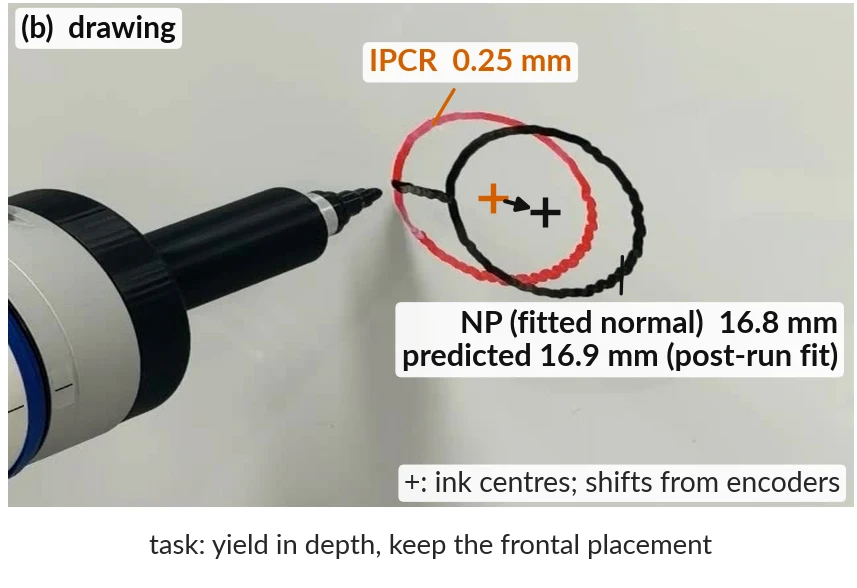
Both rules are the same controller, given a different yield direction. At ° the board plane was taped before the first run and the nearest point's shift predicted from it. On a board at about 11°, the pen drew a circle, a square and a star at 5 mm/s, IPCR and the nearest point alternating. The nearest point received the normal fitted to the board; IPCR received neither the board's pose nor its normal. The short black stroke before each black figure is the nearest-point tip sliding from the planned start to its shifted one.
Headline · prediction fixed before the runs
Circle on a board at °
The board plane was measured with a tape and committed before the first run; the nearest point's shift was predicted from it, and the criteria (IPCR within 0.5 mm, the nearest point within 0.85–1.15 of the prediction, three runs each) were set in advance. Both passed in every run.
Circle, square and star at about 11°, on video
Where the pen went
Shift of every run
Check without the encoders
In the last frames of the nearest-point videos at 11°, the centre of the black ink circle sat mm from the red one, of the encoder offset ( of pairs measurable; the registered rule asked for all, so it is reported as not met). IPCR's sub-millimetre placement itself rests on the encoders.
| Circle | Square | Star | Circle, 18°† |
|---|
Results · robot, carrying
Change the task, not the controller
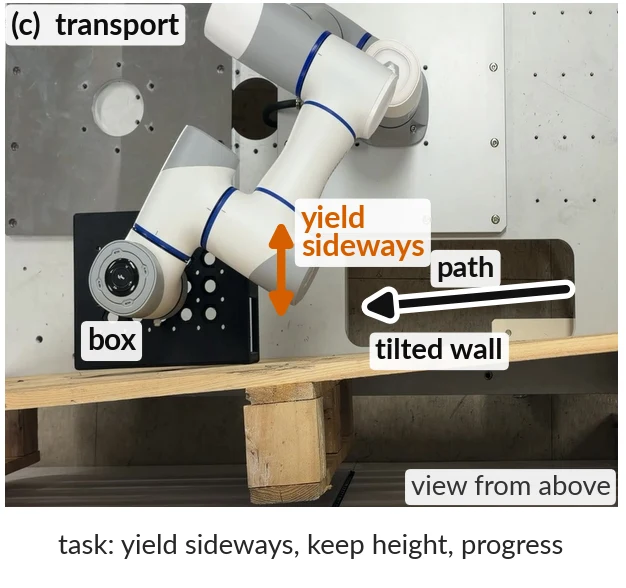
The same controller and settings carried a 250 × 200 × 150 mm box along a straight path, past a wall parallel to the path (within 0.6°) and one tilted by 4 to 5°. Transport may yield sideways and must keep progress and height. U-fixed also keeps the yaw; U-yaw lets it yield to the contact moment. One input differs.
Yaw of the box along the tilted wall
- Progress error, every run
- at most mm
- Keep yaw: attitude error
- at most °
- Yaw free: mean yaw while on the wall
- °; over the whole slide, standard deviation °, down to °
- Sideways yield
- mm keeping yaw, mm with yaw free: letting yaw go did not reduce it here (the walls were not at exactly the same angle)
Hardware setup
- Robot
- Dobot CR3A, joint sensing only
- Pen
- spring pen, 5 mm/s, one pass, 12 N target (estimated force)
- Box
- 250 × 200 × 150 mm, 8 N target; parallel and tilted wall, three runs per task and wall
- Runs shown
- drawings (11°: circle 4 and 4, square 3 and 3, star 3 and 3; °: circle 3 and 3) and carries. Excluded: runs that hit the board during set-up, one stopped by contact with a person and its pair, and box runs cancelled, stopped midway or blocked by a wall placed too far in
Results · simulation
Against other structures, on other boards
The same controller in a simulator matched to the robot. Arms, metrics and decision rules were registered before each set ( runs in this comparison, five per cell, 5 mm/s). Every other structure is given the true normal and an ideal force sensor; IPCR is given neither. Each mark is the mean of one board (log scale); grey ticks are the shift each rule predicts, .
Shift of the figure, by correction structure
×
how much farther than IPCR the six other structures moved the figure (board means; IPCR mm, others mm)
measured over predicted shift: nearest point, isotropic and force-direction compliance
/
predictions made before the runs that held on three unseen boards. The first blind set failed of cells; an audit traced it to two input constants.
mm mm
curved boards: IPCR, and the nearest point given the true local normal where it predicts a shift ( of )
The target alone is not enough
Target rule crossed with absorption direction on the full controller, true plane ( registered runs, boards at 15.6° and 23.2°). Shift of the figure:
- nearest-point target, absorbed along the normal mm
- preserving target, absorbed along the normal (as in height-sensing drawing) mm
- preserving target, absorbed along the task depth (IPCR) mm
A metric that fixes the target is half of the answer. With a 10 mm error in the believed plane, the preserving target with normal absorption leaked a further mm, as predicts, and IPCR mm.
Paper
Feasible Is Not Faithful: Task Preservation in Feasibility Restoration
Abstract
Restoring feasibility can sacrifice task coordinates: tracking a corrected reference, regulating force and keeping contact do not show that the coordinates a task prescribes were preserved. We analyze this choice for static affine corrections and test it on contact with unknown surfaces. A correction preserves task-selected coordinates when its directions lie in , and it can reach every constraint when the constraint is reachable through that subspace. For any other correction direction with invertible, the preserved coordinates move by , , where is the mismatch removed. Intent-preserving constraint realization (IPCR) implements the condition with joint sensing only, estimating no surface, normal or contact event; drawing and box transport share one setting. On hardware, the nearest-point (NP) shift of a drawn circle on an 18° board reached 1.04–1.06 of a prediction fixed before the runs (21.2–21.6 mm, against 0.21 mm for IPCR from the encoders), and on an 11° board video of the ink confirmed the NP–IPCR offset independently of the encoders. In registered simulation, structures given the true normal and an ideal force sensor moved the figure 10–36 times as far as IPCR at 0.90–1.09 of their predicted shift; a crossed design showed that with a task-aware target, absorbing the residual along the normal still leaks the predicted amount; and fixed-axis hybrid control, which meets the condition, preserved placement as well. Blind predictions on new boards failed in four of twelve cells; after an audit fixed two input constants, a separate prospective set on unseen boards passed.
Limitations
Two tilts on the robot. Drawings on the robot cover boards at about 11° and °. Only the ° prediction was fixed before the runs; at 11° the normal was fitted afterwards, so those ratios check the rule rather than forecast it.
Structures, not complete systems. We compared execution structures under ideal sensing, not complete learned policies or safety filters. The first blind magnitude predictions on new boards failed in four of twelve cells and are reported.
No force bound. IPCR's force peaks were no lower than the nearest point's; preserving intent did not suppress them. Force on the robot is estimated, not sensed: there is no force sensor on the arm. The first touch of the box reached an estimated N, and the cause of the high values is not known yet.
The nearest point carried no box on the robot. That comparison exists only in simulation.
Yaw free wavers. Over the whole slide its yaw varies by ° (standard deviation) and dips to °. Its sideways yield was not smaller than with the yaw kept.
Friction and slip. Pens slip at large approach angles on real surfaces27. Parts of some figures are faint in the videos; they are shown as recorded.
Scope. The results hold within a static affine model and concern the coordinates the task names, presuming they are named correctly. Our admittance, filters and NMPC make the absorption direction state-dependent, so the law is used as a static prediction. IPCR's remaining sub-millimetre shift is a tracking lead that hybrid position feedback removes. A curved surface's local attitude is not tracked.
Related work
Hybrid control and oblique projection. Hybrid control assigns motion and force to subspaces of the contact11,15,16,17. Filtering a twist onto the constraint is a non-unique projection set by a metric, whose choice was left to applications10,18; later work refined the formulation and the coupling between force and position loops19,20,21,22. Compliance is classically selected per task11,12. Allocation, the projector and the rank test are classical foundations; our contribution is their task-relative characterization, with the closed-form cost tested prospectively.
Unknown geometry. Slope identification from joint signals alone corrects along the normal3, and a wrong normal misplaces and distorts the target8,9; constraint estimation remains central to hybrid control23,24. IPCR's target keeps coordinates specified off the surface exact without identifying the normal.
Least-squares realization. A control-barrier-function program returns the minimum-norm correction along the constraint gradient4,5, as do constrained diffusion policies7; operational-space barrier functions weight it in task space6, yet on one plane they still correct along a weighted normal; a task-weighted metric recovers the preserving target. iTaSC specifies task outputs and can reach the IPCR target by constraining and freeing 25; we add the cost of other corrections and the separate leak of the residual.
Drawing and learned contact policies. Preserving what the task intends is a stated goal of contact control1,2. Drawing systems keep the planned in-plane position and comply along the surface normal26 or along the pen13, or project patterns along a fixed axis onto a known model and regulate the normal force27; normal compliance is the case in which the leakage law predicts a leak. Learned policies predict an interaction frame28, force or stiffness modes29 or a virtual target30, or resolve forces in an estimated contact frame2; model-based admittance uses motor-current force estimates14, and a proprioceptive reflex is trained toward a Euclidean projection1. We compare structures, not policies.
References
- Q. Nguyen, Y. Kim, and J. Lee, “Learning reflexive behavior for contact-rich manipulation,” 2026, arXiv:2610.02811.
- J. Hong, D. Song, S. Kim, and M. Seo, “Contact-aware imitation learning through contact factorization,” 2026, arXiv:2610.09533.
- Z. Doulgeri and Y. Karayiannidis, “Force/position regulation for a robot in compliant contact using adaptive surface slope identification,” IEEE Trans. Autom. Control, vol. 53, no. 9, pp. 2116–2122, 2008.
- A. D. Ames, S. Coogan, M. Egerstedt, G. Notomista, K. Sreenath, and P. Tabuada, “Control barrier functions: Theory and applications,” in Proc. Eur. Control Conf., 2019, pp. 3420–3431.
- K. P. Wabersich, A. J. Taylor, J. J. Choi, K. Sreenath, C. J. Tomlin, A. D. Ames, and M. N. Zeilinger, “Data-driven safety filters: Hamilton-Jacobi reachability, control barrier functions, and predictive methods for uncertain systems,” IEEE Control Syst. Mag., vol. 43, no. 5, pp. 137–177, 2023.
- D. Morton and M. Pavone, “Safe, task-consistent manipulation with operational space control barrier functions,” in Proc. IEEE/RSJ Int. Conf. Intell. Robots Syst., 2025.
- R. Römer, A. von Rohr, and A. P. Schoellig, “Diffusion predictive control with constraints,” in Proc. Learn. Dyn. Control Conf., PMLR vol. 283, 2025, pp. 791–803.
- Y. Karayiannidis and Z. Doulgeri, “Blind force/position control on unknown planar surfaces,” IET Control Theory Appl., vol. 3, no. 5, pp. 595–603, 2009.
- Y. Karayiannidis and Z. Doulgeri, “Robot contact tasks in the presence of control target distortions,” Robot. Auton. Syst., vol. 58, pp. 596–606, 2010.
- H. Lipkin and J. Duffy, “Hybrid twist and wrench control for a robotic manipulator,” ASME J. Mech., Trans., Autom. Des., vol. 110, no. 2, pp. 138–144, 1988.
- M. T. Mason, “Compliance and force control for computer controlled manipulators,” IEEE Trans. Syst., Man, Cybern., vol. 11, no. 6, pp. 418–432, 1981.
- J. M. Schimmels and M. A. Peshkin, “Force-assembly with friction,” IEEE Trans. Robot. Autom., vol. 10, no. 4, pp. 465–479, 1994.
- D. Song, J. Park, and Y. J. Kim, “SSK: Robotic pen-art system for large, nonplanar canvas,” IEEE Trans. Robot., vol. 39, no. 4, pp. 3106–3119, 2023.
- H. Shi, S. Hu, Y. Hou, W. Wang, K. Liu, and S. Song, “Minimalist compliance control,” 2026, arXiv:2603.00913.
- M. H. Raibert and J. J. Craig, “Hybrid position/force control of manipulators,” ASME J. Dyn. Syst., Meas., Control, vol. 103, no. 2, pp. 126–133, 1981.
- O. Khatib, “A unified approach for motion and force control of robot manipulators: The operational space formulation,” IEEE J. Robot. Autom., vol. 3, no. 1, pp. 43–53, 1987.
- H. Bruyninckx and J. De Schutter, “Specification of force-controlled actions in the ‘task frame formalism’—a synthesis,” IEEE Trans. Robot. Autom., vol. 12, no. 4, pp. 581–589, 1996.
- J. Duffy, “The fallacy of modern hybrid control theory that is based on ‘orthogonal complements’ of twist and wrench spaces,” J. Robot. Syst., vol. 7, no. 2, pp. 139–144, 1990.
- W. D. Fisher and M. S. Mujtaba, “Hybrid position/force control: A correct formulation,” Int. J. Robot. Res., vol. 11, no. 4, pp. 299–311, 1992.
- R. Featherstone, S. S. Thiebaut, and O. Khatib, “A general contact model for dynamically-decoupled force/motion control,” in Proc. IEEE Int. Conf. Robot. Autom., 1999, pp. 3281–3286.
- J. De Schutter, D. Torfs, H. Bruyninckx, and S. Dutré, “Invariant hybrid force/position control of a velocity controlled robot with compliant end effector using modal decoupling,” Int. J. Robot. Res., vol. 16, no. 3, pp. 340–356, 1997.
- Z. Doulgeri, N. Fahantidis, and A. Konstantinidis, “On the decoupling of position and force controllers in constrained robotic tasks,” J. Robot. Syst., vol. 15, no. 6, pp. 323–340, 1998.
- T. Yoshikawa and A. Sudou, “Dynamic hybrid position/force control of robot manipulators—On-line estimation of unknown constraint,” IEEE Trans. Robot. Autom., vol. 9, no. 2, pp. 220–226, 1993.
- E. Nasiri and L. Wang, “Hybrid force motion control with estimated surface normal for manufacturing applications,” in Proc. Int. Conf. Ubiquitous Robots, 2024, pp. 125–132.
- J. De Schutter et al., “Constraint-based task specification and estimation for sensor-based robot systems in the presence of geometric uncertainty,” Int. J. Robot. Res., vol. 26, no. 5, pp. 433–455, 2007.
- D. Song, T. Lee, and Y. J. Kim, “Artistic pen drawing on an arbitrary surface using an impedance-controlled robot,” in Proc. IEEE Int. Conf. Robot. Autom., 2018, pp. 4085–4090.
- T. Weingartshofer, C. Hartl-Nesic, and A. Kugi, “Automatic and flexible robotic drawing on complex surfaces with an industrial robot,” IEEE Trans. Control Syst. Technol., vol. 32, no. 5, pp. 1602–1615, 2024.
- H. Fang et al., “Force Policy: Learning hybrid force-position control policy under interaction frame for contact-rich manipulation,” in Proc. Robot.: Sci. Syst., 2026.
- Y. Yang et al., “TDC: Sim-to-real transferable directional compliance for contact-rich manipulation,” 2026, arXiv:2602.14174.
- Y. Hou, Z. Liu, C. Chi, E. Cousineau, N. Kuppuswamy, S. Feng, B. Burchfiel, and S. Song, “Adaptive compliance policy: Learning approximate compliance for diffusion guided control,” in Proc. IEEE Int. Conf. Robot. Autom., 2025, pp. 4829–4836.
Works cited on this page, numbered as in the manuscript.
Cite
@unpublished{kim2026ipcr,
  title  = {Feasible Is Not Faithful: Task Preservation in
            Feasibility Restoration},
  author = {Kim, Jeonghyeon and Park, Shinsuk},
  note   = {Manuscript in preparation},
  year   = {2026}
}