Ladder-Crossing Robot
Abstract
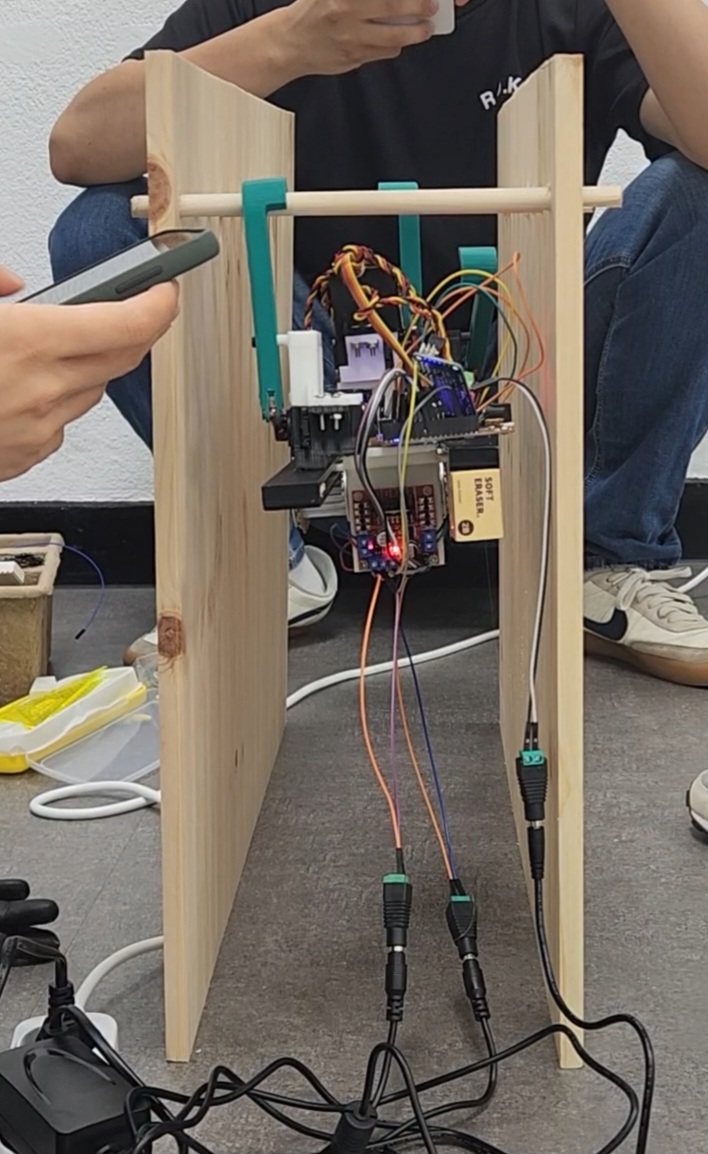
Led a five-person team to design and build a robot that climbs a horizontal ladder by gripping successive rungs and shifting its center of mass forward, without falling. The arm joints are tendon-driven by fishing line rather than rigid linkages — simple to 3D-print, but prone to slack once a joint’s return force is too slow. Iterated through three physical prototypes to resolve that and two other structural issues before arriving at the final design.
Method
- Arm joints: driven by fishing-line tendons through 3D-printed links; slack after fast release fixed by retuning motor-driven return speed
- Joint rigidity: early single-pin joints couldn’t brace each other under load; widened each joint to a two-pin, double-walled 3D-printed interface, reinforced with a backing plate and tape until the geometry itself was redesigned
- Link length vs. rung pitch: a mismatch between link length and the gap between fishing-line anchor points forced a geometry revision, verified with a kinematic link simulation before the final 3D print
- Drive: step motors for body/base locomotion, servo motors for arm actuation, coordinated via Arduino
Results
Validated through three prototype iterations (sketch-scale mockup → reinforced full-scale print → final geometry), with motor spacing further adjusted from feedback during in-class testing to keep the body narrow without shortening the arm’s effective reach.
Skills
Arduino Creo NX C++